
August 7, 2026
Kitchen Cabinet Costs in Metro Detroit for 2026
TL;DR
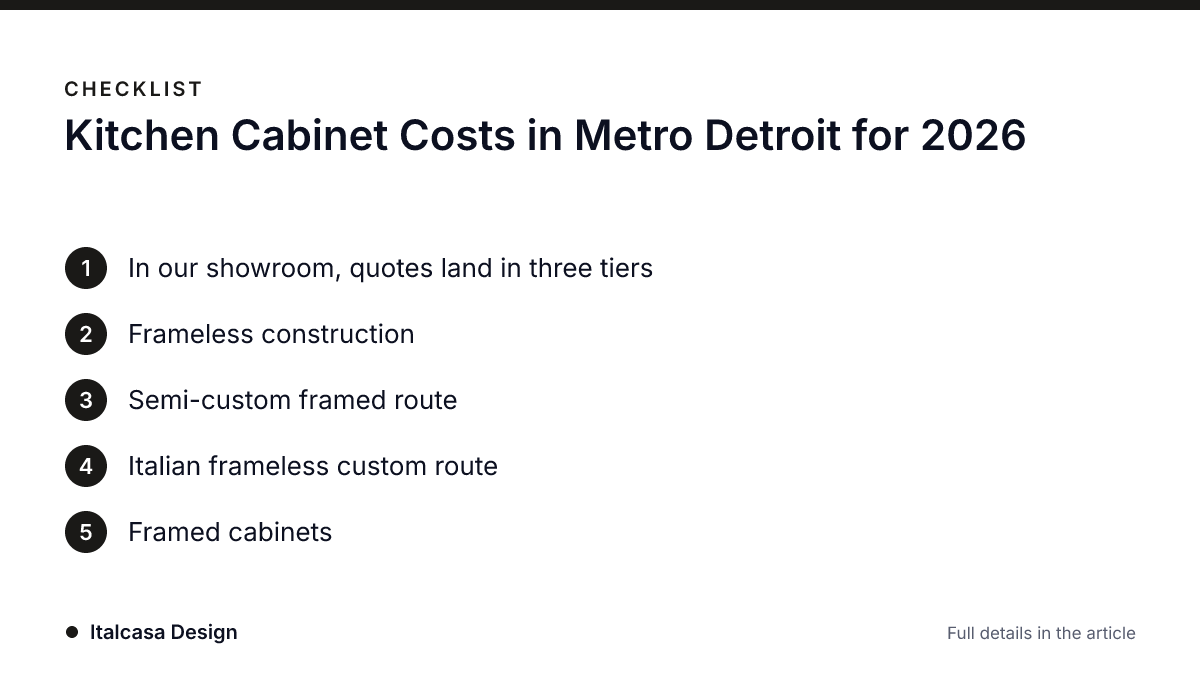
- In our showroom, quotes land in three tiers: stock and RTA cabinets around $100–$300 per linear foot installed, semi-custom framed around $400–$750, and Italian frameless custom systems from roughly $900 to $1,800+ depending on finish and hardware.
- A typical 10×12 kitchen needs about 25–30 linear feet of cabinetry, so a full remodel with boxes, hardware, and installation can run from about $6,000 (RTA) to $50,000 and up (Italian custom).
- Frameless construction is the default on Italian cabinetry, and it buys you roughly an extra 1.5 inches of opening width per cabinet compared with the framed boxes most American retailers sell.
- Italian brands like Lago are specified as one system: cabinets, island, hardware, and lighting drawn together instead of assembled from three separate shopping trips.
- A studio that handles customs clearance and white-glove installation absorbs the freight tracking, the storage, and the on-site assembly you'd otherwise own yourself.
If you're pricing kitchen cabinets right now, here's the honest range we quote in Metro Detroit: $6,000 to $15,000 for a basic stock or RTA kitchen, $18,000 to $35,000 for semi-custom framed cabinetry with professional installation, and $35,000 to $80,000+ for a custom Italian kitchen with premium hardware, integrated appliances, and a matching island. Where you land depends on construction, materials, kitchen size, and who hangs the boxes.

Table of Contents
- What is the average cost to put in kitchen cabinets?
- Framed, frameless, and RTA: what's the real difference?
- What Italian cabinet brands can you actually get in Metro Detroit?
- Home Depot, Lowe's, Amazon, or an Italian design studio?
- Where do the island, countertops, and hardware fit into the budget?
- Do the same Italian brands make bathroom cabinets too?
- How do you actually get started?
- Frequently asked questions
What is the average cost to put in kitchen cabinets?
Across the projects we price, installed kitchen cabinets in Metro Detroit fall between about $150 and $700 per linear foot including materials and labor. Most full kitchens total $12,000 to $40,000. That's a wide spread because the word "cabinets" covers flat-pack boxes you assemble in your garage and hand-finished Italian systems built to the millimeter.
Here's how the tiers typically shake out for a standard 10×12 kitchen (roughly 28 linear feet of cabinetry):
| Cabinet type | Price per linear foot (installed) | Estimated total, 28 linear feet | Best for |
|---|---|---|---|
| RTA (ready-to-assemble) | $100–$300 | $2,800–$8,400 | Rentals, budget flips, DIY installers |
| Stock cabinets (big-box) | $150–$350 | $4,200–$9,800 | Starter homes, quick remodels |
| Semi-custom framed | $400–$750 | $11,200–$21,000 | Mid-range remodels, standard layouts |
| Custom frameless (Italian) | $900–$1,800+ | $25,200–$50,400+ | Luxury builds, open-concept kitchens, designer projects |
Pro tip: Ask whether a quote includes installation, delivery, and hardware before you compare anything. Plenty of online RTA sellers advertise the box price alone. Add soft-close hinges, crown molding, filler strips, and a contractor to hang it all level, and that "$4,000 kitchen" is closer to $9,000 by the time the last door goes on.
Run the math on a real kitchen
Say you're remodeling a 300-square-foot kitchen with 28 linear feet of cabinetry, including a 6-foot island. The formula is simple: linear feet × per-foot rate, plus the island, plus labor if it isn't bundled.
- Semi-custom framed route: 28 ft × $600/ft (mid-range of that tier) = $16,800 for cabinetry. Add roughly $3,500 for the island box and $2,000–$4,000 in installation labor. Total: $22,300–$24,300.
- Italian frameless custom route: 28 ft × $1,200/ft = $33,600 for cabinetry. Add a matching island system at $6,000–$9,000, with white-glove delivery and installation typically inside the quoted price. Total: $39,600–$42,600.
The gap is about $18,000 on this kitchen. What the higher number buys is soft-close everywhere, integrated lighting, panel-ready appliance fronts, and a layout engineered as one piece rather than stitched together from stock widths.
To model your own numbers, walk the kitchen with a tape measure, add up every cabinet run including the island, then multiply by the per-foot range of the tier you're considering. A useful threshold: if your linear footage times the semi-custom rate already exceeds what you're comfortable spending, the Italian tier isn't a stretch you should force. Shrink the footage or phase the project instead.
Framed, frameless, and RTA: what's the real difference?
Construction style matters more than the sticker price once you're opening those doors five times a day.
- Framed cabinets have a face frame, a wood border around the front of the box that doors and hinges attach to. It's the traditional American build, structurally forgiving and cheaper to produce. That frame also eats about 1.5 inches of opening width per cabinet. On a standard 24-inch base, you're reaching through roughly 20.5 inches instead of 22.5. Multiply that across a dozen cabinets and you've lost a whole drawer's worth of storage.
- Frameless cabinets (European or "full access") skip the face frame. The door mounts directly to the box, so you get the full opening, easier drawer access, and a cleaner line. Nearly every premium Italian manufacturer builds this way by default. It isn't an upgrade line item.
- RTA (ready-to-assemble) cabinets ship flat and get built on site, usually with cam locks and dowels rather than screws. As Kitchen Cabinet Kings explains, RTA is popular because it cuts shipping costs and skips a factory markup. The tradeoff: you're the one squaring boxes on a Saturday, and the joinery rarely matches a factory-assembled frameless system.
| Factor | Framed | Frameless | RTA |
|---|---|---|---|
| Interior storage space | Less; frame narrows the opening | More; full access to the box | Varies, often less |
| Look | Traditional, ornate trim options | Clean, modern, minimal hardware | Depends on finish quality |
| Assembly | Factory-built | Factory-built | Customer or contractor assembles |
| Best kitchen layout | Traditional or transitional | Open-concept, modern, tight galleys | Budget remodels, rentals |
| Longevity | Good if well-built | Excellent with quality hinges | Variable by brand |
Pro tip: In a small or awkward footprint, and Royal Oak and Ferndale bungalows are full of them, frameless pays for itself in storage alone. One more caution for older Metro Detroit homes: plaster walls from the 1920s are almost never plumb, and kitchen floors often slope a half inch across a run. Italian cabinetry arrives in metric modules, so a good installer plans scribe fillers and a leveled toe-kick base before the first box goes up. Skip that step and you'll see the gap at the ceiling line forever.
What Italian cabinet brands can you actually get in Metro Detroit?
There's a tier of Italian manufacturers most homeowners here never encounter, because they don't sell through big-box channels at all. They sell through design studios and showrooms. Brands like Lago draw entire kitchen systems instead of individual boxes: the island, the hardware, the lighting, and the finish palette all specified together from the factory.
The practical difference shows up at the order stage. At a big-box retailer you're picking from a set of stock widths, usually in 3-inch increments, and closing the leftover inches with filler strips. Italian systems get specified to your room. Cabinet depths, island proportions, and finish palettes are drawn against your actual dimensions.
One detail that trips up almost every first-time buyer: panel-ready appliances. If you want the refrigerator and dishwasher to disappear behind cabinet fronts, we need the exact appliance models before the order goes to Italy, because the panel dimensions and hinge clearances are built around them. Homeowners who pick appliances after the cabinets ship end up with a filler panel where a clean front should be. Decide the appliance package first.
Our kitchen and bath design team works from full room measurements and 3D renderings before anything ships, so you're approving cabinet fronts, island proportions, and hardware finish on paper rather than discovering them on delivery day. You can browse every manufacturer we carry on our brands page and see individual lines on products.
Home Depot, Lowe's, Amazon, or an Italian design studio?
It comes down to how much customization and coordination the project actually needs. Home Depot's kitchen cabinet selection and Lowe's cabinetry lineup are genuinely good when you know your layout, want a set delivery date, and are comfortable hiring your own installer. Amazon listings work the same way: fast, standardized, fine for a rental or a straight swap.
Those channels get strained by anything non-standard. A waterfall island edge. A run that has to die into a structural column. Panel-ready appliance integration. Matching finishes across a kitchen, a wet bar, and a bathroom vanity. That's where a full-service studio earns its markup.
- Design coordination: One team specs cabinets, island, hardware, and lighting together, so nothing looks bought on three separate trips.
- Customs clearance and warehousing: Italian cabinetry ships internationally. We clear customs and hold pieces in a local warehouse, so you're not tracking a container across the Atlantic or stacking pallets in your garage while drywall gets finished.
- White-glove delivery and installation: Boxes arrive assembled and protected, installed by people who've set that manufacturer's hardware before instead of a generalist decoding a proprietary soft-close mechanism.
- Trade pricing for designers: If you're specifying for a client, our trade program gives direct pricing across 40+ Italian brands.
Pro tip: Doing a refacing job where the boxes stay and only doors change? Big-box or online is the smarter budget move, full stop. Save the studio for a gut remodel or new construction, where the coordination is the whole point and you're not troubleshooting mismatched finishes six months after move-in.
Where do the island, countertops, and hardware fit into the budget?
Cabinets are the biggest line, rarely the only one. A kitchen island with seating, storage, and a waterfall countertop typically runs $4,000 to $15,000 on its own, separate from the perimeter. Countertops (quartz, natural stone, or the porcelain slabs common in Italian kitchens) generally add $60 to $200 per square foot installed. Hardware looks minor per piece and isn't: pulls and specialty hinges run roughly $15 to $60 each, and a 28-foot kitchen easily takes 35 to 40 of them.
If you're budgeting cabinets and countertops together, ask for one combined quote rather than two. Bundled pricing almost always beats sourcing from separate vendors, because template, delivery, and installation get coordinated into one visit instead of two crews scheduling around each other.
Pro tip: On a high-end kitchen with a real ceiling, put the money into box construction and hinges, the parts your hands touch daily, and take a mid-tier quartz instead of an exotic slab. Nobody comments on the stone after year two. Everybody notices a door that thuds.
Do the same Italian brands make bathroom cabinets too?
Most manufacturers we carry for kitchens also build matching vanities and bath storage, which matters if you want the door style, wood tone, and hardware to carry from the kitchen down the hall to the primary suite. Bathroom cabinets from these brands typically run $250 to $900 per linear foot depending on size, storage configuration, integrated lighting, and whether the vanity floats.
If you want a floating vanity, tell your designer during framing, not after drywall. Wall-hung units need solid blocking behind the finish surface, and retrofitting that means opening a wall you just tiled. We've had to make that call more than once. It's always cheaper to add two hours of blocking during rough-in.
Our kitchen and bath design team specs both rooms together on whole-home projects, which keeps finishes consistent instead of hunting a "close match" from another vendor a year later.
How do you actually get started?
Most projects open with a walkthrough, either at our Royal Oak or Troy showroom or on site if demo has already started. Bring rough measurements, photos, and whatever inspiration images you've been saving.
- Initial consultation. Budget, timeline, layout goals, plus a walk through the showroom so you're touching finishes and hardware rather than judging them on a screen.
- Design and 3D rendering. Our interior design team builds the layout to your real dimensions, so island proportions and cabinet runs are settled before anything is ordered.
- Order, customs, and warehousing. Once you sign off, we manage the import and hold your pieces locally until the site is ready.
- White-glove delivery and install. Cabinets arrive assembled and go in with a crew that already knows the hardware and finish.
Designers should ask about the trade program before speccing anything, since direct pricing across 40+ brands changes a lot of client budgets. Restaurant owners, hospitality developers, and office clients should start at our commercial services page, because contract specs and warranties run on different rules than residential. Staging a listing rather than renovating? Our home staging team can furnish the kitchen and living space without any cabinet investment.
Frequently asked questions
How long does a full kitchen cabinet installation take?
Once cabinets are on site, a standard semi-custom install takes 3 to 5 days. The full project, counting design, ordering, and ocean freight, usually runs 8 to 14 weeks for custom Italian cabinetry, and longer when countertops and appliances have to land in the same window.
Can I mix cabinet brands in one kitchen to save money?
You can, though it's risky without a designer holding the specs together, since cabinet depths, reveal dimensions, and drawer hardware rarely line up between manufacturers. If budget is driving the decision, use one brand for everything in sightlines and a cheaper line for the pantry or laundry.
Do Italian kitchen cabinets hold up in Michigan's climate?
Yes, when they're acclimated before installation. Quality Italian manufacturers use moisture-resistant substrates and finishes built for European humidity swings, which track close to ours. Let the boxes sit in the conditioned house a few days before install, especially in January when furnace air is bone dry. Hinge and hardware quality drives longevity far more than country of origin, which is why soft-close is worth paying for on any brand.
Measure your linear footage this week, multiply it by the tier you're leaning toward, and you'll know within a few thousand dollars where you stand. Then get started with a design consultation at our Royal Oak or Troy showroom, or use our contact page to schedule a walkthrough.
Planning a project of your own?
Start a Conversation